
Skittles Science Experiment for Kids


Here’s a fun skittle science experiment to do with your kiddos! They will watch in amazement as the colors spread!
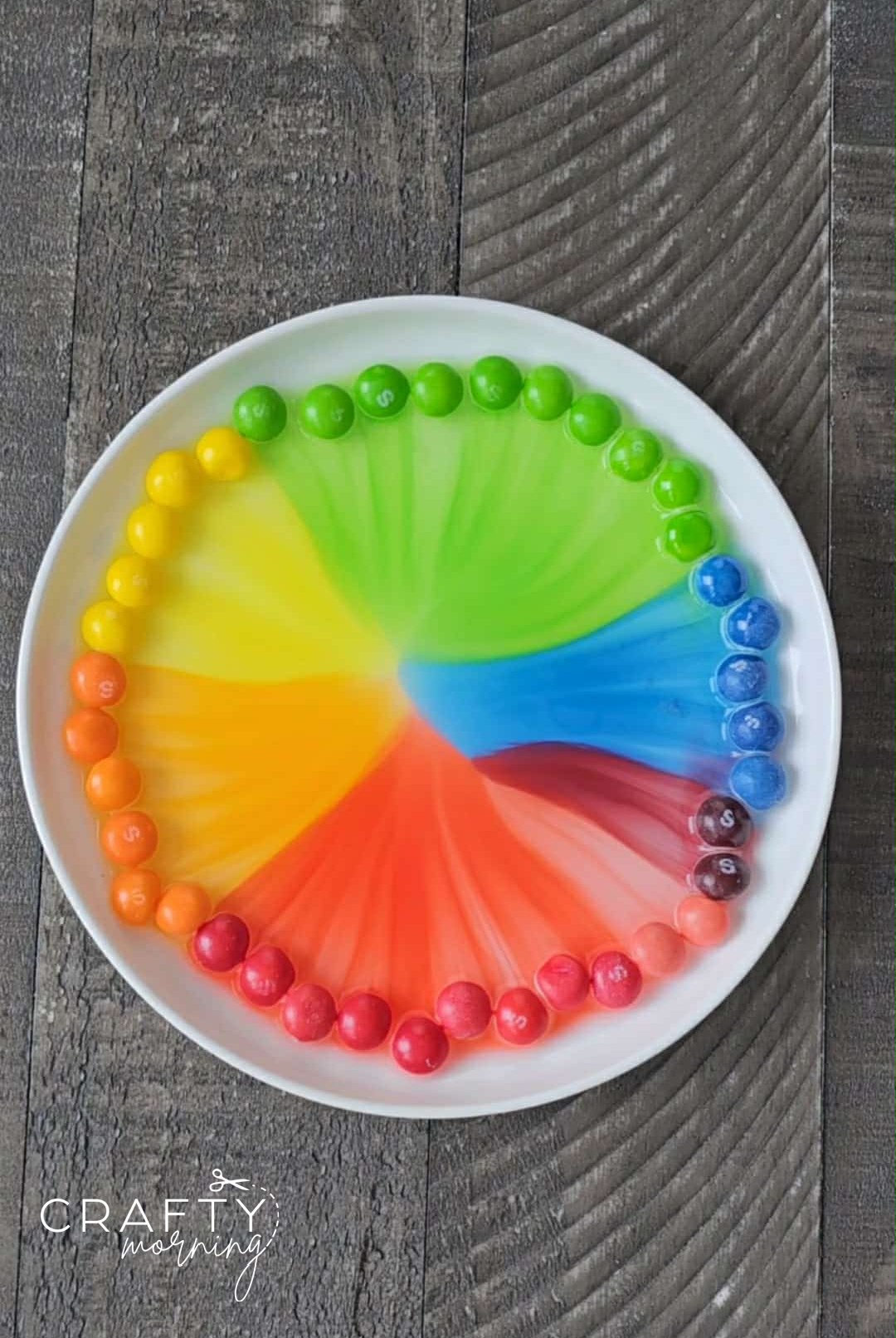
1. The candy coating dissolves quickly
Each Skittle is coated with sugar and food coloring. When water touches the surface, that coating begins to dissolve almost immediately. The surrounding water becomes “loaded” with colored sugar.
2. Diffusion moves the color outward
Once the color dissolves, it starts to spread through the water. This process is called diffusion—particles naturally move from crowded areas (near the Skittle) to less crowded areas (the empty water around it).
3. No mixing at first creates clean color lines
You might notice the colors spread but don’t immediately mix together into brown. That’s because:
- The water stays fairly still on the plate.
- The dissolved sugar from each Skittle creates a tiny barrier where it meets the sugar from another Skittle.
- This barrier slows down mixing, forming those sharp lines between colors.
4. Density differences help keep colors separate
The colored sugar water near each Skittle is denser (because there’s more sugar dissolved in it). Where two colors meet, the water is closer in density, so the layers don’t swirl together right away.
5. Eventually everything mixes
As time passes, the water moves slightly and diffusion continues. The separated colors gradually merge into one uniform mixture.
Here’s a red, white, and blue skittle experiment made Kelli Hansen…so cool!
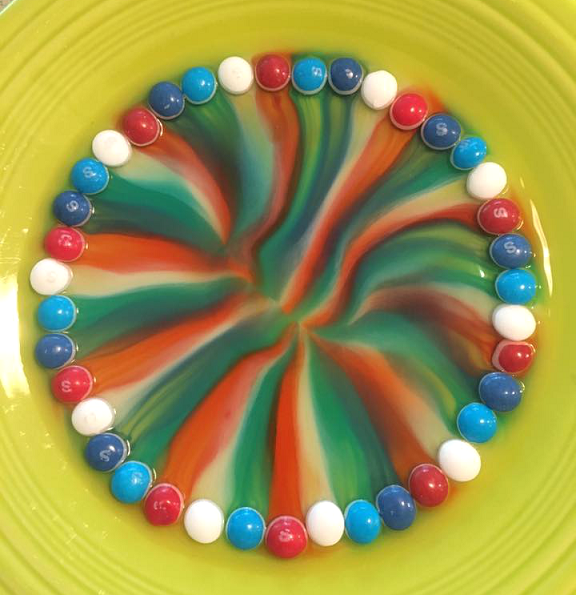
Watch it in action…
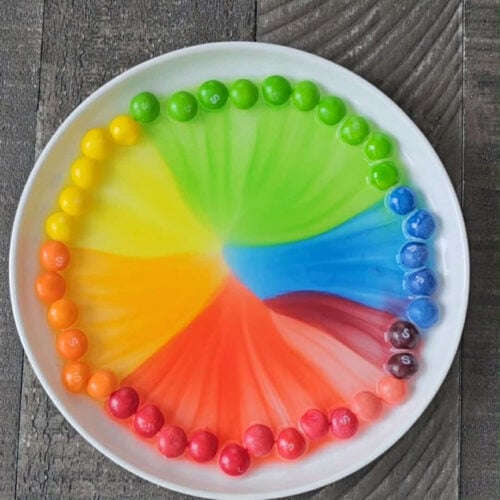
Skittles Experiment
Materials
- Skittles
- Water
- Cup
- Round Plate
Instructions
- Have your little ones make a circle with different colored skittles on a round plate.
- Slowly pour water into the center of the circle until the plate is just covered.
- Watch the colors form within 1-2 minutes!


Love it Michelle. If me and my nephew can resist eating all the skittles this is going to look aweome.
Absolutely awesome idea! I think i’m gonna try this one.